THE JOURNEY FROM I TO WE
Six Questions for Practicing Belonging
Hope Beyond Borders begins with a simple conviction:
We belong to one another.
Knowing that and living it are very different things.
We live among many kinds of borders. Some are geographic. Others are political, cultural, racial, religious, economic, or generational. Still others are the invisible lines separating the people we recognize as “us” from those we experience as “them.”
The six questions of Hope Beyond Borders invite us to explore what happens when that circle begins to widen. They are not six lessons or six conclusions. They form a journey from encounter toward belonging, courage, home, mutual care, and shared creation.
1. I SEE YOU
What happens when we truly see another human being?
Every journey toward belonging begins with encounter.
Before there can be a “we,” there must first be an “I” willing to see a “you”—not simply a label, category, statistic, stereotype, problem, or cause, but a person.
Practice: SEE
2. I MAKE ROOM FOR YOU
How can we widen our circle of belonging?
Seeing another person presents us with a choice.
We can retreat to the comfort of our existing circle—or allow the encounter to change the shape of the circle itself.
Belonging does not require us to erase our identities.
It asks whether our circle of “us” can grow.
Practice: WIDEN
3. I RISK SOMETHING FOR YOU
What does courage look like in everyday life?
Belonging becomes more meaningful when something is at stake.
Courage may involve comfort, certainty, reputation, status, relationship, or safety.
Most peace heroism is not dramatic. It appears when ordinary people decide that something matters more than remaining comfortable or silent.
Practice: RISK
4. THERE IS A PLACE FOR YOU HERE
What makes a place feel like home?
Home is more than geography.
At its deepest level, home is the experience of knowing:
I am seen.
My story matters.
I am safe enough to be myself.
I do not have to become the same as everyone else in order to belong.
Practice: WELCOME
5. WE CARRY IT TOGETHER
What are we carrying alone?
Every person carries things that may be invisible to everyone else—grief, fear, trauma, loneliness, disappointment, hope, regret, or stories never told.
Much of what divides us is visible.
Much of what connects us is hidden.
A community of belonging becomes increasingly capable of helping people carry what should not have to be carried alone.
Practice: CARRY
6. WE CREATE TOGETHER
What can we create together that none of us can create alone?
The journey arrives at “we.”
But we does not mean sameness.
A choir offers a useful metaphor. Harmony does not require everyone to sing the same note. It requires different voices to know their parts—and to listen beyond them.
Community works much the same way.
Practice: CREATE
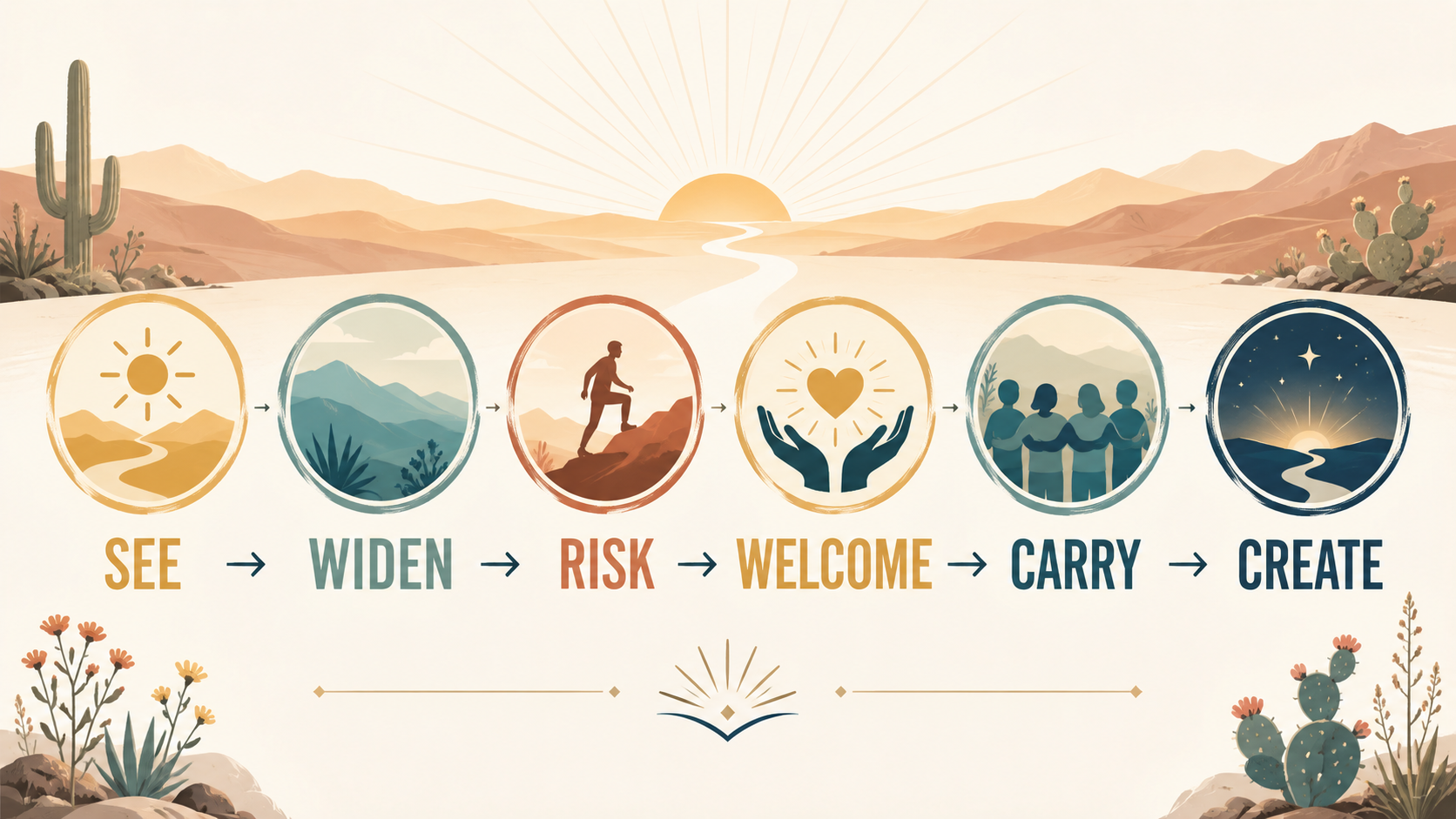
SEE → WIDEN → RISK → WELCOME → CARRY → CREATE
The movements are not a staircase. We return to them again and again as life presents another relationship, another border, another disagreement, another fear, or another possibility.